How to Choose Your First Prime Lens for UK Street Photography
British street photography happens in tight spaces and flat light. You are wedged between a bus shelter and a shop window on a wet Tuesday, waiting for the crowd to thin, watching a woman in a red coat walk towards a puddle. A prime lens — one focal length, no zoom ring — suits that sort of shooting unusually well. It is small, it copes with dim afternoon light, and it forces you to learn where to stand. Picking your first one comes down to three decisions: focal length, aperture and size.
Your kit zoom is not the problem. Most modern zooms are sharp enough for anything you will print or post. The argument for a prime is behavioural. With a single focal length you stop fiddling with the ring and start watching the street. You learn, within a week, exactly how far away you need to be for a head-and-shoulders frame or a full figure in context. That knowledge is what makes candid work quick.
The second argument is light. A fast prime gives you a brighter viewfinder, faster autofocus in gloom, and the option of shooting at f/2 in a covered market in November without pushing your ISO into mush. The third is that a small lens on a small body attracts far less attention than a zoom extended to 70mm.
Everything below is quoted as full-frame equivalent, with the nearest common crop-sensor option in brackets. This is the only decision that really matters, so take your time over it.
If you genuinely cannot decide, choose 35mm. It is the compromise that gives up the least.
Fast sounds better than it is. At 35mm and f/1.4, focused on someone two metres away, the zone of sharp focus is a matter of centimetres. For candid work you will usually be at f/4 to f/8 anyway, because that is where you can catch a moving subject reliably.
What a wide aperture genuinely buys you in the UK is a usable shutter speed at four in the afternoon in December. An f/1.8 or f/2 prime is the sensible sweet spot: light enough for grey days and indoor markets, small enough to slip into a coat pocket, and far cheaper than the f/1.4 versions. If you shoot a lot of evening and night scenes, f/1.4 earns its extra weight and cost. Otherwise, f/2 is plenty.
One practical trick worth learning early: set the lens to f/8, focus at roughly three metres, and everything from about two to seven metres stays acceptably sharp. You can then shoot without touching focus at all.
On a British high street, the camera matters less than the lens sticking out of it. A pancake or compact prime reads as a tourist snapshot camera; a long black zoom reads as something to be wary of. Smaller also means you can walk for four hours without your shoulder complaining, and it fits under a coat when the rain starts.
Look for an aperture ring if your camera supports it — you can set exposure by feel without raising the camera to your eye. A quiet, quick autofocus motor helps in quiet places. Weather sealing is nice in drizzle, though a lens cloth and a plastic bag will see you through most British weather.
You are not buying a number, you are buying an angle of view. Work out what 35mm equivalent means for your body before you spend anything.
On the practical side, photography in public places in the UK is generally fine for personal work, but stations, shopping centres and some markets set their own rules — check signage and ask staff if you are unsure. For anything commercial, look up current guidance rather than trusting a forum thread.
Buy the small, unglamorous lens and use it for everything: the walk to the shops, the bus queue, your friends in a pub. One focal length, learned properly, will teach you more about framing than a bag of zooms ever will.
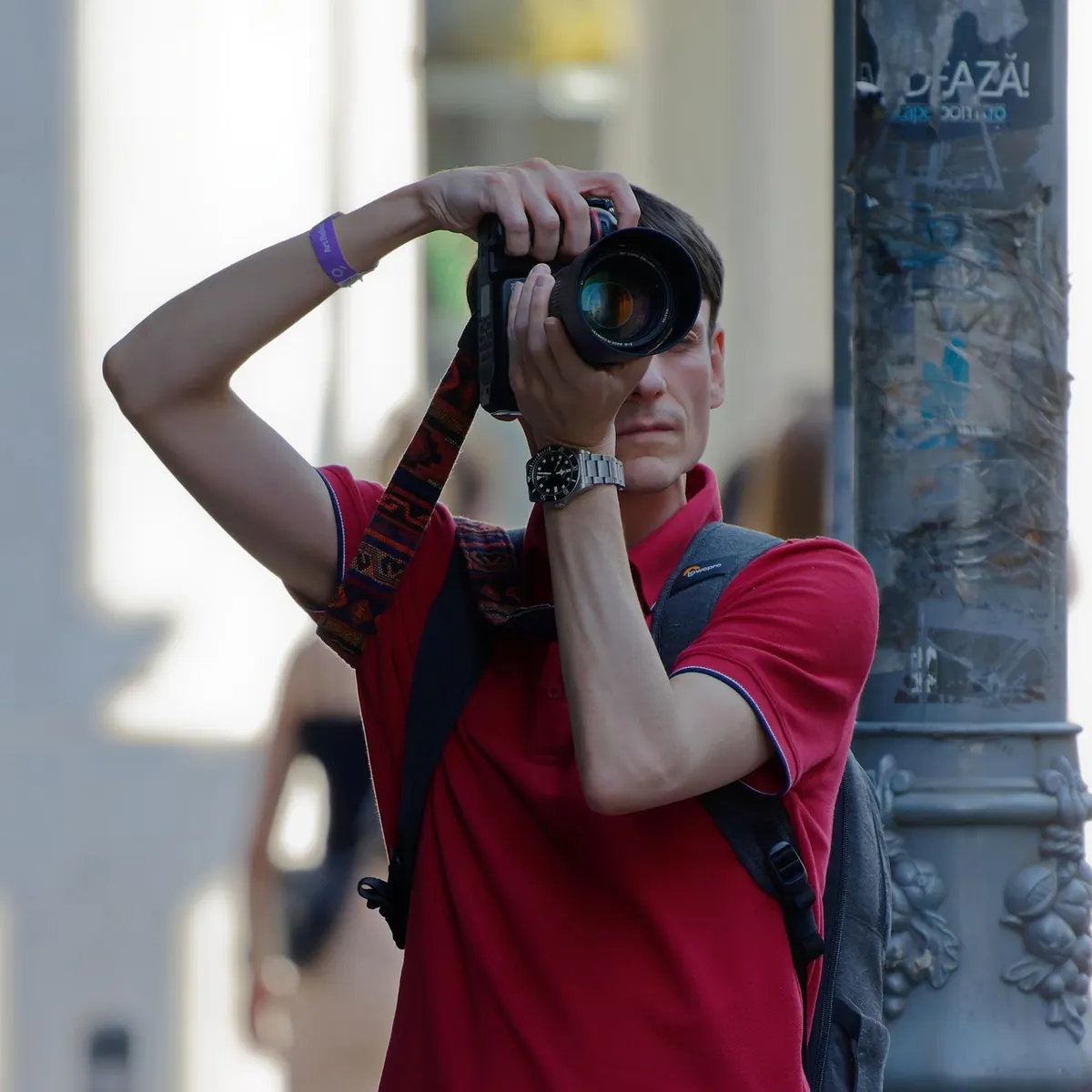
Photo: Surprising_Media / Pixabay