Review: Best Budget 50mm Lenses for UK Beginners
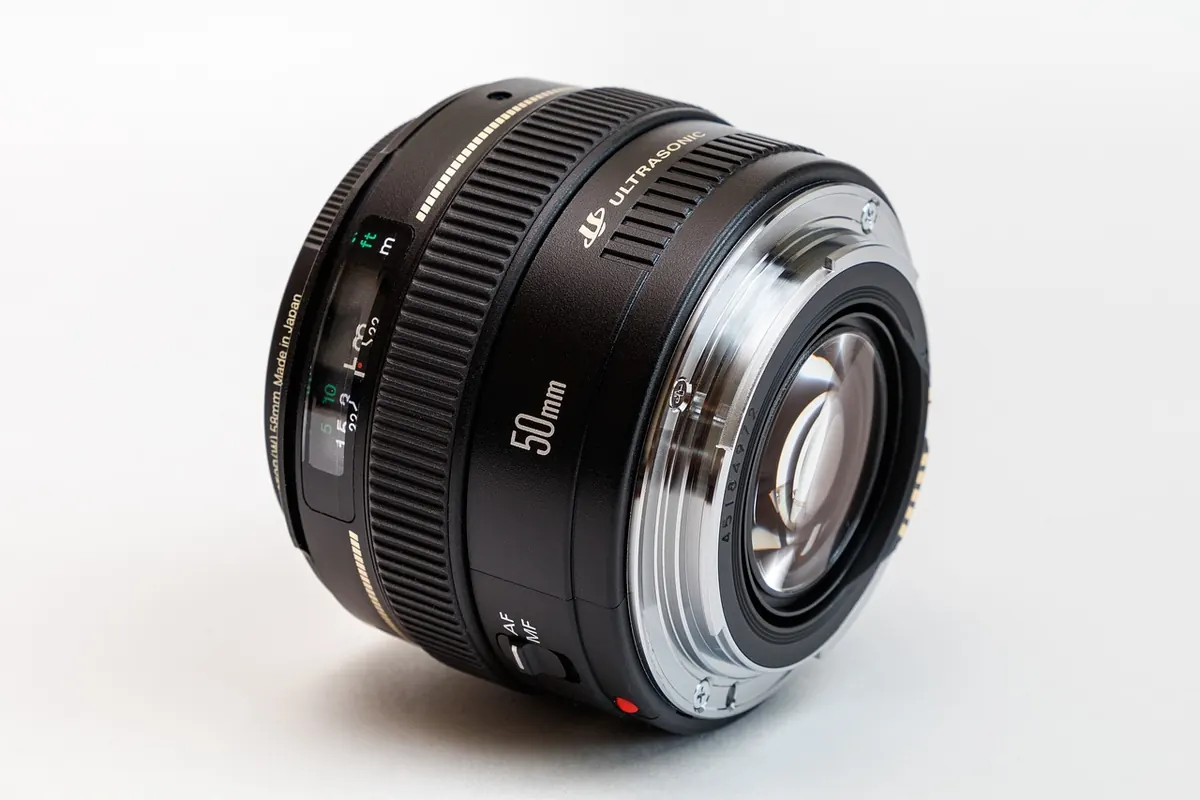
A standard prime is the cheapest route to noticeably better pictures. A 50mm f/1.8 lets in a great deal more light than the zoom that came with your camera, weighs almost nothing, and quietly teaches you to move your feet instead of twisting a ring. That last part matters more than any specification.
The awkward bit is that "budget" plays out differently depending on which camera you own. A 50mm is a true standard lens on full frame, a short portrait telephoto on APS-C, and tighter again on Micro Four Thirds. Here's what your money actually buys, which lenses earn their place, and how to avoid the usual traps.
Almost every affordable 50mm is built on the same idea: a simple optical formula, a bright maximum aperture, a small barrel and very little else. You aren't paying for weather sealing, stabilisation or exotic glass, and you don't need to. What you're paying for is light and shallow depth of field, and those two things do most of the work in a beginner's first year.
The focal length itself should be your first consideration. On full frame, 50mm is the classic "what your eye sees" view. On Canon APS-C it behaves like an 80mm, on Nikon, Sony and Fujifilm APS-C like a 75mm, and on Micro Four Thirds like a 100mm. That's a lovely portrait length and a cramped one for photographing a room full of people. If you want the standard look on a crop sensor, look at a 35mm instead — or a 25mm on Micro Four Thirds.
Modern budget 50s are sharper than their price suggests, but only in the right conditions. Wide open, expect a crisp centre, softer corners, and some glow and purple fringing against bright edges. Stop down to f/2.8 and the corners tidy up; by f/4 to f/5.6 the whole frame looks excellent, and it stays that way until diffraction softens things around f/11.
Sample variation matters more than brand names at this end of the market. Two copies of the same lens can differ visibly, usually because one element sits slightly off-centre. Before you accept a lens, shoot a flat, textured surface — a brick wall is the traditional victim — square-on and wide open, then compare the four corners on your computer. If one side is consistently mushier, ask for another copy.
Remember that focus accuracy beats outright sharpness. A modest lens that lands on the eye looks better than a sharper one that lands on an ear. Test with real subjects, close up and wide open, in decent light.
The motor inside is the biggest practical difference between cheap lenses. Stepper motors — Canon's STM, Nikon's AF-P among others — focus quietly and smoothly, which helps stills and video alike. Older micro-motor designs are noisier and hunt in dim light: fine for landscapes, less pleasant for photographing a child who won't sit still.
Third-party lenses vary widely. Some focus quickly and quietly; others are noticeably slower and occasionally miss. Manual-focus lenses from makers such as TTArtisan and 7Artisans are cheap and often beautifully built, but you focus them yourself, and on some bodies you set the aperture on the ring too. That's a deliberate choice, not a fault — just don't buy one expecting autofocus.
Plastic bodies are fine and light, and a metal mount is a bonus rather than a requirement. On mirrorless cameras, several budget 50s use focus-by-wire, so the ring feels electronic rather than mechanical — harmless, but odd if you're used to older glass. None of these lenses enjoy rain; treat them accordingly and they'll last.
The EF 50mm f/1.8 STM is the default answer for DSLRs and works on RF bodies through an adapter. If you shoot mirrorless, the RF 50mm f/1.8 STM is tiny and focuses quietly.
The AF-S 50mm f/1.8G is the obvious F-mount pick. On Z bodies, affordable 50s are thinner on the ground — the Z 40mm f/2 is the budget standard-ish option worth considering.
The FE 50mm f/1.8 suits full frame, while the E 50mm f/1.8 OSS adds stabilisation and a tighter view for APS-C. Viltrox and Samyang both make autofocus 50s worth a look.
Pentax's DA 50mm f/1.8 is light and inexpensive. On MFT, a 25mm f/1.7 or f/1.8 gives you the standard field of view instead.
The f/1.8 versions are the sweet spot. The f/1.4 versions cost considerably more for
Photo: Alexei_other / Pixabay
Previous Post
A Lens Kit for UK Coastal Photography: What to Pack for Seascapes
Next Post
What Do Lens Numbers Mean? Focal Length, Aperture and Stabilisation Explained