70-200mm vs 100-400mm for Wildlife Photography: Which Lens Suits You?
There is a moment every wildlife photographer knows. Something appears at the edge of the frame, you lift the camera, and the subject is either too small or too dark to make a picture. The lens you chose an hour earlier decides which of those problems you have. Between a 70-200mm and a 100-400mm, that choice comes down to four things: reach, light, weight and how far you are prepared to walk.
A 70-200mm is built for subjects you can get close to and light you cannot control. It is the classic lens for red squirrels at a feeding station, deer in a country park, or a fox that has grown used to people. The f/2.8 versions are what photographers reach for at dawn; the f/4 versions are what they actually carry all day.
A 100-400mm is built for distance. It trades maximum aperture for reach, usually sitting somewhere around f/4.5–5.6 at the long end. It is rarely the faster lens, but it is often the one that gets the picture at all.
Reach is not magnification on paper; it is how much of the frame your subject fills. A robin at two metres is a portrait at 200mm. The same robin at eight metres is a small bird in a large picture, and no amount of careful focusing changes that.
Going to 400mm roughly doubles the subject's size in the frame. In British habitats that is often the difference between a record shot and a photograph. Park deer, squirrels visiting a hide and gannets on a cliff ledge are approachable enough that 200mm works. Waders on a mudflat, a bittern in reeds, a hobby hunting over a heath — those are 400mm subjects, and even then you will crop.
You can crop with a high-resolution sensor, but you pay in pixels and in how much enlargement the file will take before it falls apart. Filling the frame is still the better habit.
The 70-200mm has a clear advantage here. An f/2.8 zoom lets in two stops more light than a typical f/4.5–5.6 telephoto. That is the difference between 1/500sec at ISO 1600 and 1/500sec at ISO 6400, or between freezing a kingfisher's dive and blurring it. In a wood in November, or on a saltmarsh an hour after sunrise, those two stops are everything.
The fast lens also gives shallower depth of field, which separates a subject from a busy background. That matters less at 400mm, where the focal length compresses the background anyway and f/5.6 can still produce pleasing blur. What the 100-400mm offers instead is a workable compromise: a slower shutter braced on a post, a higher ISO, and a sensor that handles noise well enough.
The two are often closer in weight than people expect, but a 70-200mm f/2.8 is usually the heavier of the pair and noticeably front-heavy on a small body. Add a converter and a battery grip and the combination starts to dictate how far you walk — and whether you bother at all.
Think about the whole day, not the shot. A 100-400mm that stays on your shoulder for six hours on a coastal path beats an f/2.8 left in the car. Balance matters as much as grams: a lens that sits comfortably in the hand can be shot at 1/250sec; one that tips forward constantly cannot.
A 1.4x converter turns a 70-200mm into roughly a 98-280mm f/4, which reaches into 100-400mm territory without buying a second lens. A 2x converter gets you to 400mm at f/5.6, but autofocus slows and sharpness and contrast usually suffer. Check that your camera body will autofocus at the resulting aperture before you rely on it.
Crop sensors shift the arithmetic in your favour. A 400mm lens on an APS-C body gives a field of view similar to 600mm on full frame. That is not extra reach in a physical sense, but it puts more pixels on a distant subject — useful for small birds, less useful when you want the whole scene.
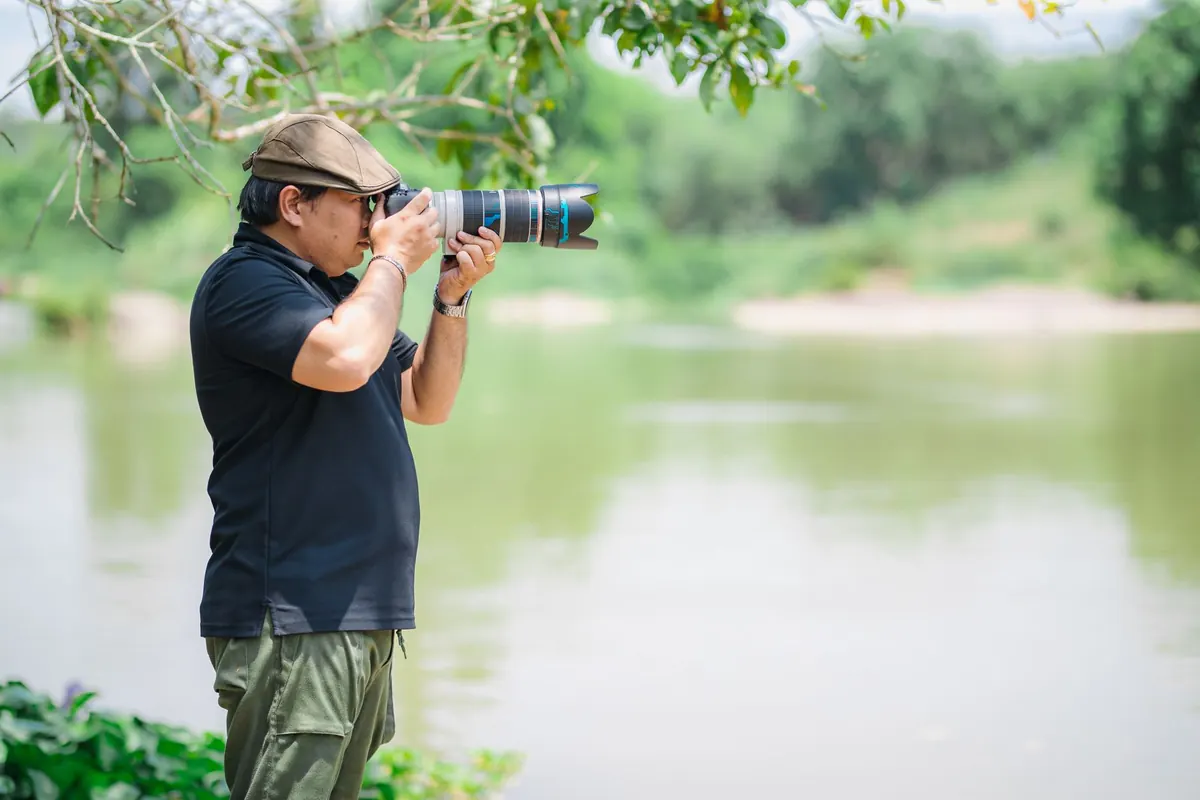
Photo: Bảo Minh / Pexels
Previous Post
A 10-Point Checklist for Buying a Used Lens in the UK
Next Post
Lens Mounts Explained: A Beginner's Guide to Fitting Lenses